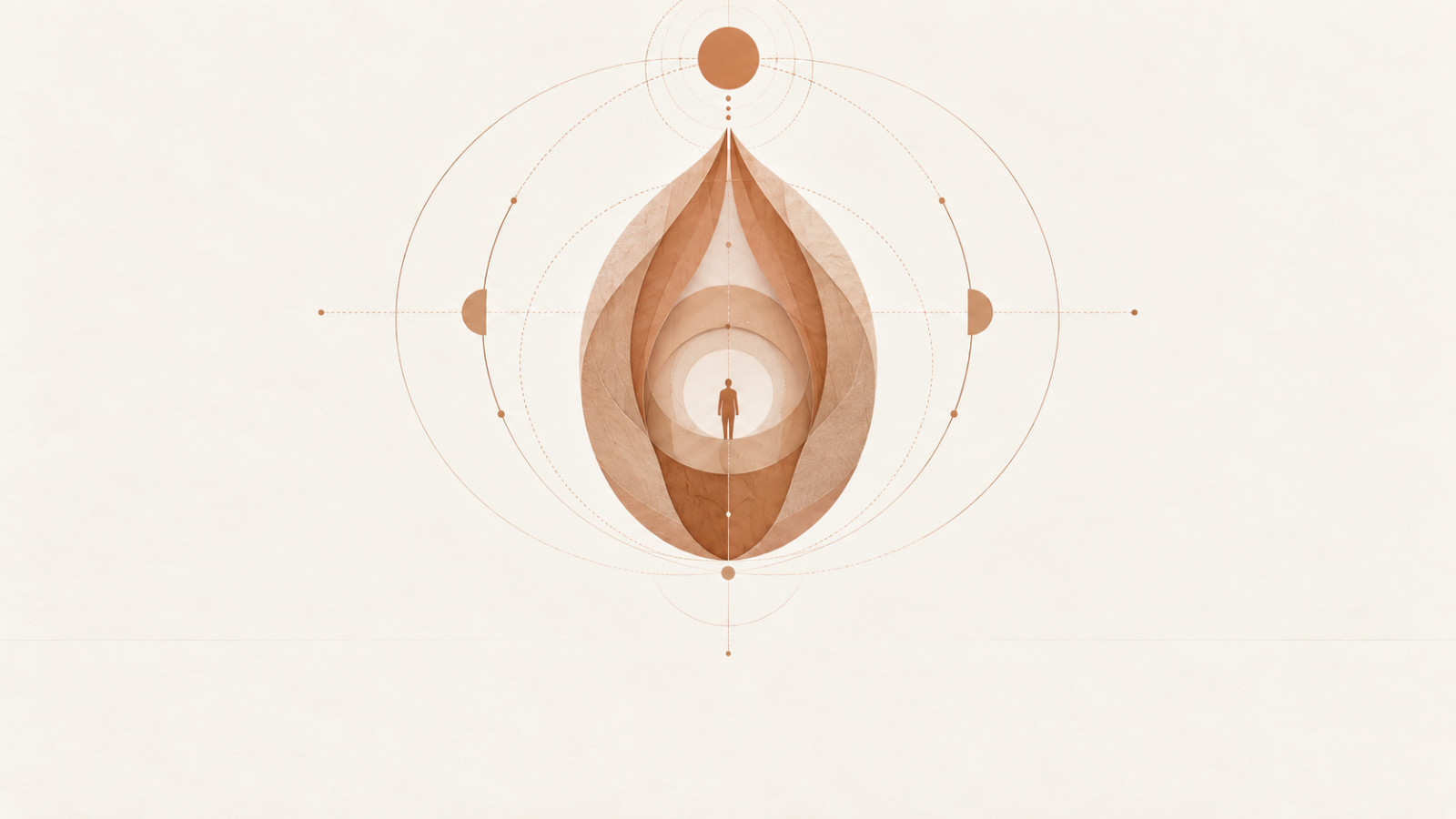
We say “I” very easily.
I think. I feel. I want. I have decided.
We put everything we are inside that word, as if it were a single thing. But when you look closely, you begin to make out two different realities.
There is the character: the idea you have of yourself, the story you recognise as your own, the particular way you look at the world.
And there is the vehicle that character inhabits: the body.
Together they make up a life. But they are not the same thing.
You can know your character’s story very well and still not know how the body living it works.
The character you call “I”
The character is not a lie, nor a mask that has to be destroyed.
It is the concrete form you have learned to recognise as you. It has a name, a history, a way of interpreting what happens. It knows what it likes and what it rejects. It remembers what was done to it. It imagines what it might become.
It has also built an explanation of itself.
It may believe it is strong, responsible, independent, sensitive, difficult, generous, or incapable of finishing what it starts. Some of those things belong to it. Others it learned because someone repeated them to it for a long time.
If you never observe the character, you end up living inside its story without knowing it is a story. You defend roles you may no longer need. You make decisions to keep up an image of yourself. You confuse what you have had to be with what you really are.
Knowing the character does not mean judging it. It means seeing it.
Knowing where it looks from. What it is trying to protect. What role it keeps repeating. Which part of its story is authentic and which part was built in order to fit in.
The vehicle has no opinion of itself
The body works differently.
It does not need to explain itself. It does not need to build an identity. It does not ask whether it is doing things right.
It responds, opens, closes, tenses, relaxes. It has a rhythm, an amount of energy, a way of nourishing itself, an environment in which it breathes more easily, and a specific way of recognising what is correct.
The body does not argue. It informs.
The problem is that we learned to listen to the character’s voice long before the vehicle’s signals. The mind can spend hours building a reason to move forward while the body has been saying no for days. It can convince itself that a place is perfect while the organism shrinks every time it walks in.
And because the body does not use words, we tend to think it has said nothing.
The vehicle is always speaking. The hard part is not getting it to answer, but no longer answering for it.
When they live as strangers
A great deal of suffering is born there: from the character and the vehicle living the same life without knowing each other.
The character builds a direction out of what it believes it ought to achieve. The vehicle tries to take it somewhere else. One speeds up. The other wears out. One insists. The other falls ill, locks up, or loses its energy altogether.
From the outside it can look like a lack of willpower, fear of change or an inability to decide.
But very often it is something simpler: we are trying to force a body to sustain a life that does not match its nature.
That is when the feeling of drifting appears. Not necessarily because there is no direction, but because we are looking for that direction in the wrong place.
We ask the character where it wants to go before we have met the vehicle it will have to make the journey in.
Why this body in particular
We tend to treat the body as if it were the wrapping of something more important.
But no purpose can exist without a form that makes it possible.
Not just any body could live your life. Not just any nervous system would perceive what you perceive. Not just any sensitivity would have passed through your experiences in the same way. Your energy, your limits, your vulnerability, and even what for years you have considered a flaw all take part in the direction of your existence.
There are bodies made to sustain a constant energy and others that need to learn to manage it. There are bodies that find clarity by responding, others by waiting, others by moving through their own wave. Some perceive what is happening within a group. Others see the person in front of them with extraordinary precision.
None of these forms is better.
Each one allows a different journey.
That is why getting to know the vehicle changes the question. It is no longer about finding out why your body does not work like everyone else’s. It is about understanding why it needs to work exactly the way it does — what it is for.
Your body is not the obstacle that separates you from your purpose. It is the exact form your purpose needed in order to exist.
What a chart can show
For me, a Human Design chart serves precisely to make this difference visible.
On the one hand it shows the mechanics of the vehicle: how its energy moves, where it finds authority, what it takes in from outside, what it needs in order to process experience correctly.
On the other, it lets you recognise the character that inhabits it: its perspective, its motivation, the way it is prepared to look at life, and the role it ends up taking on once it stops trying to play another.
The chart does not decide for either of them. It does not drive the vehicle or write the character’s script.
It introduces them.
And that introduction can be deeply revealing, because many people have spent their whole lives trying to turn the vehicle into the character they had imagined. They have demanded from the body the energy needed to keep up an identity, instead of allowing their identity to discover the body it actually has.
Knowing your design is not about memorising labels. It is about observing whether what appears on the map also appears in your life.
That is where real knowledge begins.
Direction appears
When the character understands the vehicle, something relaxes.
It no longer needs to force it to follow every plan it imagines. It learns to recognise its timing, its responses and its limits. It stops reading every halt as a failure and every change of course as a mistake.
The vehicle, for its part, does not need to become anything. It only needs to stop being driven against its own nature.
Direction, then, does not arrive as a great revelation. It appears little by little, in decisions that weigh less, places where the body breathes more easily, relationships in which you do not have to bend yourself out of shape, and movements that do not require constant explanation.
You do not always know where you are being taken.
But you begin to recognise that the life you are travelling is your own.
The great purpose
When we talk about purpose we tend to imagine a mission, a profession or something extraordinary we ought to do before we die.
But purpose is not always something you do.
It is the way this particular consciousness passes through life inside this particular body. It is what emerges from the meeting between the character’s gaze and the vehicle’s possibilities.
You do not need to manufacture a great purpose with the mind. Nor to find a sentence that sums it up.
You need to know well enough who is making the journey, and the body that is carrying them.
Then purpose stops being hidden in the future. It begins to reveal itself in the way you walk, choose, relate to others and take your place.
The character can look.
The vehicle knows how to move.
And when the two stop being strangers, life stops being a trip like any other and becomes your journey.
If something you have read here resonates with you, we can talk.
Write to me