People sometimes ask me what exactly I do in a session. And the short answer sounds disappointing: I listen.
But listening has layers. And what happens between what a person tells me and the map they leave the session with is a concrete process, one that can be described. I am going to describe it.
First, the whole story
At the beginning I do nothing. I let the person talk.
I do not interrupt to put things in order, I do not ask questions to steer, I am not yet looking for anything in particular. I need the complete story, exactly as they bring it — with its repetitions, its detours, its parts that seem beside the point.
That matters, because what seems irrelevant to the person is usually precisely what says the most. And what they bring well ordered, well explained, with cause and effect neatly fitted together, is almost always what says the least.
So I let it all fall. Unfiltered. That is the raw material.
The story is not the information
Here is the first misunderstanding worth undoing: what a person tells you about their life is not the information about their life. It is an interpretation already made.
We all arrive with a constructed account. With the guilty parties identified, with explanations we have repeated so many times that they already sound like truth, with a character we have learned to be inside our own narration — the victim, the strong one, the one who endures, the one who does not fit.
That account is not a lie. But neither is it the data. It is what the mind did with the data in order to be able to live with it.
If I worked on the account, I would be working on a layer that already comes interpreted. And you cannot orient anyone with a map they drew themselves while they were lost.
What you tell me is not what happened to you. It is what your mind did with what happened to you so that you could carry on.
The sieve
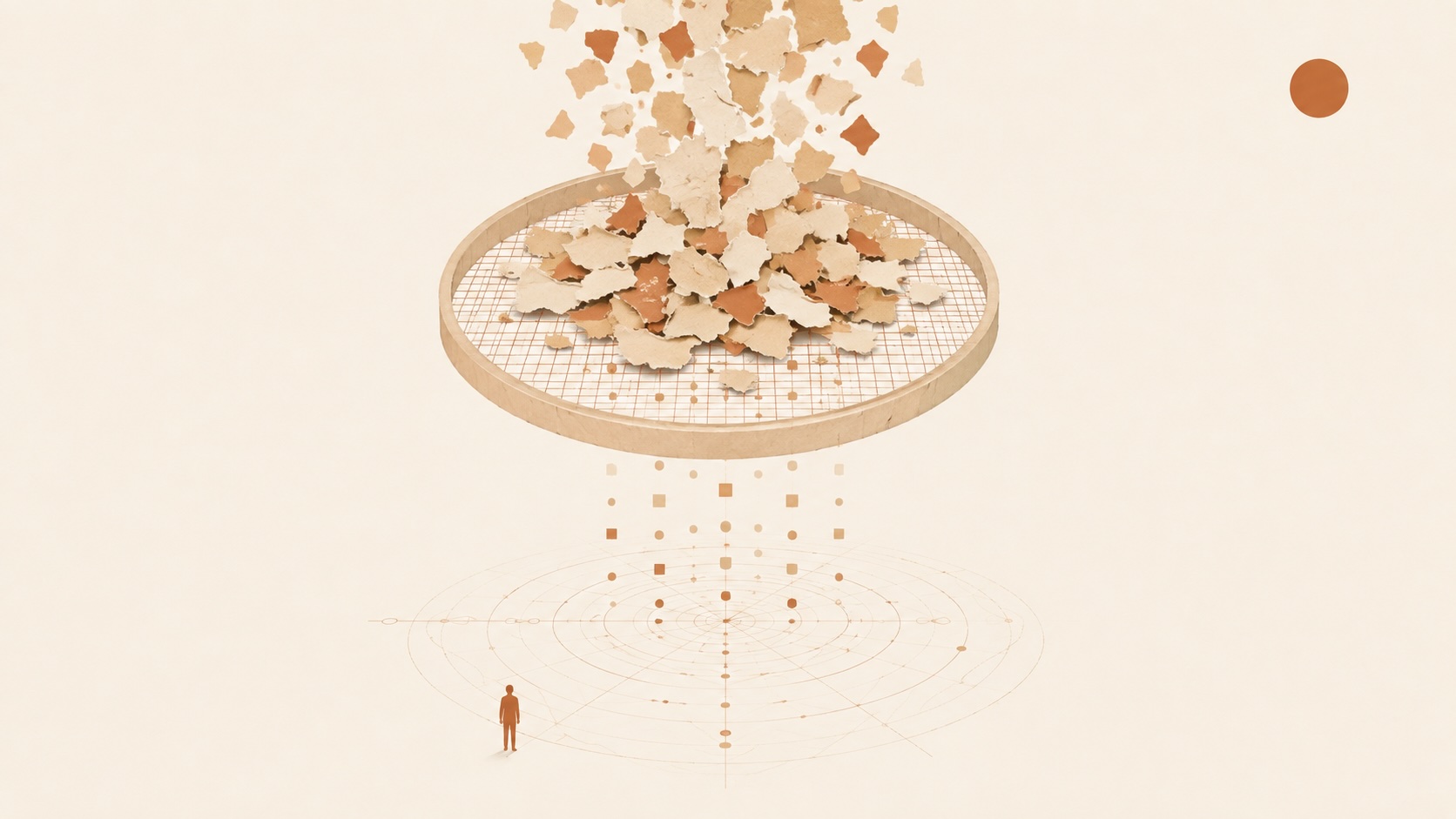
So I pass all the material through a sieve.
A sieve does not choose. It does not decide what is important. It only has a mesh size, and what does not fit stays on top and what fits goes through. It is a stupid instrument, and that is why it works.
What stays on top, what does not go through: the interpretations, the blame handed out, the diagnoses the person has already given themselves, other people’s opinions taken on as their own, the part of the account that exists to justify themselves to someone.
What passes through, what stays underneath: the bare facts. What repeats in situations that have nothing to do with each other. What the body did before the mind explained it. The incoherences — the moments when the person says one thing and their body says another. And the exceptions: the times when the pattern did not hold, which are usually more revealing than the pattern itself.
At the end of the filtering, far less is left than went in. A handful of pieces of information. But they are real.
The sieve is not looking for what is important. It only lets through what really weighs. And it is almost never what the person came to tell me.
Ordering what remains
A handful of loose facts is no use either. They have to be put in relation to one another.
This is where Human Design comes in, and it comes in at a very particular place: as a grid. Not as an answer.
The chart tells me where to look. Which areas of that person are defined and which are not, where other people’s conditioning gets in, where their real authority lies and from where they have been deciding in its place. When I cross the filtered data with that structure, the pieces stop being loose anecdotes and start to form a drawing.
And then something happens that never stops surprising me: it is not I who finds the pattern. The person finds it. All I have done is put the pieces close enough together for it to be visible.
The map
What comes out of that is a map. Not a plan, not a diagnosis, not a list of things to correct. A map.
A map has a very precise and very limited function: it tells you where you are and what is around you. It does not tell you where to go. It does not walk for you. It does not promise you the road will be comfortable.
But it changes one fundamental thing: you stop moving blind. And a person who knows where they are makes different decisions from a person who is lost — even if the terrain is exactly the same.
That is why I do not work on the problem people bring me. I work with the person who brings it. The problem, almost always, turns out to be an accident of the terrain that looks small as soon as there is a map.
I give you the map. You walk the road. And that part is not negotiable — not because I do not want to, but because it cannot be done.
What stays on top
One question remains: what about everything that did not go through the sieve?
It is not thrown away. That is yours too, and it also says something — but it says something about how you have had to tell yourself your life in order to bear it, not about what happened. It is a construction, and constructions are made for a reason. Almost always to protect oneself.
That is why I do not attack it. There is no need to dismantle anyone’s account: I simply do not build the map on top of it. When the map appears, the account usually lets go by itself, without anyone having to tear it away.
What is needed is that you can leave it on the table for a moment. That there be at least a crack between what happened to you and what you have decided it meant.
If that crack does not exist — if every fact comes welded to its interpretation and there is no way of separating them — there is nothing to filter. And then we do not begin.
If something you have read here resonates with you, we can talk.
Write to me